What If the Body Remembers Joy? The Science of Embodied Memory, Pleasure & Intimacy
We know the body holds trauma. But what if it also holds delight, desire, and joy — and what if those experiences can become available to us again?
We talk often about trauma carried in the body. About the nervous system remembering what happened to us — the ways an old experience can live on in a tightened jaw, a guarded belly, a flinch, a frozen response, a body that says no before the mind has had time to understand why.
But what if the body carries more than what hurt us?
What if it also carries what delighted us? What opened us? What made us laugh so completely that we forgot ourselves — that made us feel beautiful, wanted, powerful, innocent, mischievous, tender, or exquisitely alive?
And what if some of those experiences can return? Not simply as stories we tell about the past, but as sensations, feelings, and possibilities available again in the present.
There is fascinating science behind this question. Research on embodied memory suggests that remembering an experience can involve reactivating the sensory and sensorimotor patterns associated with it. Research on positive autobiographical memory has found that recalling happy experiences engages the brain's systems for reward, emotion, and memory. In other words, remembering is not always just telling ourselves a story about what once happened. Our remembered experiences can involve the body, the emotions, and the brain, together.
I find that beautiful.
Because for more than thirty-five years, I have watched people encounter something in themselves that seems to have been waiting beneath the story they thought was the whole truth.
What if the body remembers more than pain?
I have spent most of my adult life inside this question.
Quodoushka is difficult to explain to someone who has never experienced it. It is a ceremonial exploration of intimacy, sexuality, embodiment, relationship, and spirit — and it is where I first learned to trust what happens when we slow down, regulate, and allow. It can be tender. It can be confronting. It can be playful. It can be extraordinarily intimate.
And sometimes, over the course of several days, something happens that ordinary language struggles to hold.
A person arrives carrying a story about who they are. Then the story begins to loosen — not because someone tells them it's wrong, but because they discover that something else is true at the same time.
I watched this happen recently with a woman I'll call Catherine.
She arrived with so much armor that even gentle touch could feel intrusive. There were moments when she wanted to bolt. At one point, she came close to leaving altogether.
Her history was real. Her defenses had reasons.
And yet there was another woman inside that history.
During one of our practices, she chose an innocent, shy quality for herself while her partner stepped into a more dominant role. But dominance, in this context, was not about conquest. It was about steadiness. Leadership. The willingness to remain present enough that another person could discover what it felt like to be safely met.
Something began to change. She discovered that surrender did not have to mean disappearing. He discovered that power could be tender. She discovered that being led could feel safe. For a few days, they became something more deeply bonded than either had expected.
They reached limits. They paused. They talked. They reconnected. They tried again.
There was no magic wand. There was something more interesting: her body was having a different experience.
At the start of the gathering, she could barely look into my eyes. There was a tic near one of them, and a vigilance that seemed almost impossible to penetrate. Five days later, she was beaming.
Later, she told me her partner had bought her exquisite jewelry — a kind of gift that had not been part of their relationship before. I don't know what that gift meant to her. I don't know what will happen next in their marriage, or whether every old pattern dissolved.
That isn't the point. Something had become possible that had not seemed possible when she walked through the door.
The story is true. And it isn't the whole truth.
When the anger wasn't the whole story
Another man, whom I'll call Kevin, arrived almost completely shut down — angry, frozen, blank. At one point he, too, wanted to leave.
Rather than trying to persuade him to feel differently, asked a question. What do you really want?
"Freedom from this prison."
And then: What do you really need?
"Peace. Freedom. Love."
As he stayed with the questions, something underneath the anger began to surface. He spoke about isolation. And then came the realization: "I'm the one who did it. I let it happen. I feel crushed."
I stayed with him. Then came another question. Is it entirely true that you are in a prison?
No. Not entirely.
And if it isn't entirely true — what else might be true?
He found another answer. He was a man seeking. A man who had stayed.
The story hadn't disappeared. It had become larger.
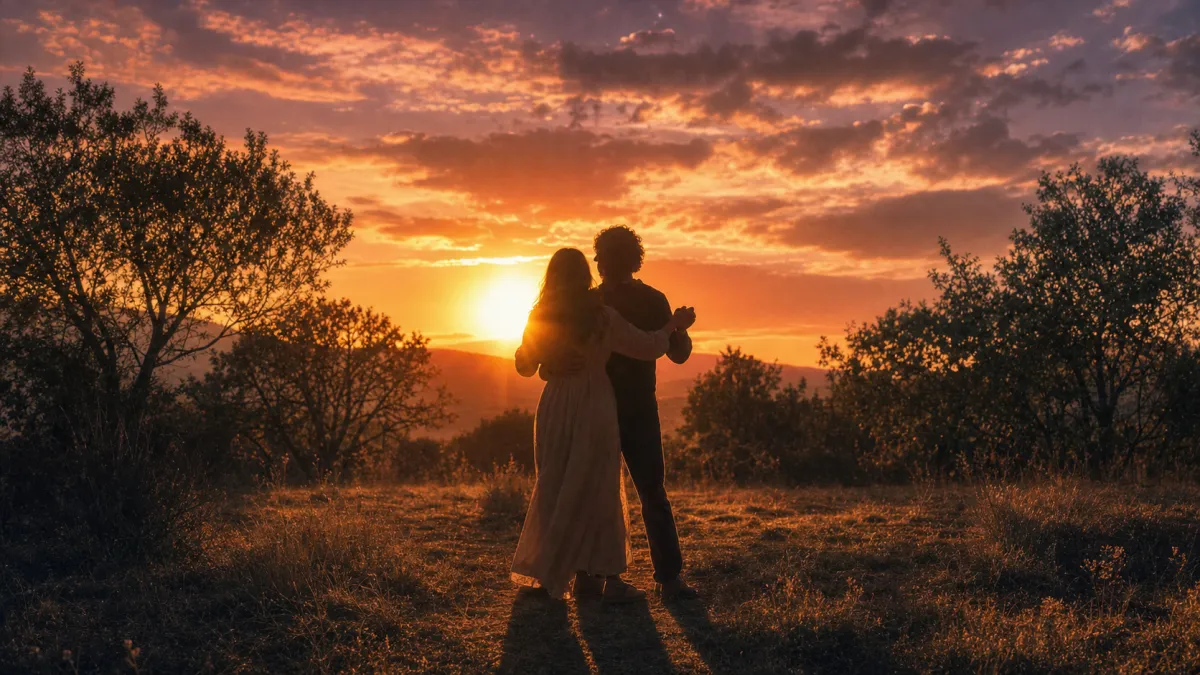
Later, he and his wife made a playlist together, including a song from when they first met, and danced beneath the moon and stars inside the open-air dome. I have no idea whether one night of dancing repaired everything between them — I doubt anything as complicated as a marriage can be reduced to a single beautiful evening. But dancing became possible.
Sometimes that is where transformation begins.
Sometimes the body needs a new experience
This is something I've come to understand more deeply over the years: we can know something intellectually and still not know it in our bodies.
We can know that we are loved and still brace when someone reaches for us. We can know that we are safe and still feel the impulse to run. We can know that our partner desires us and still struggle to let ourselves be desired. We can understand that surrender is not weakness while some deeper part of us still believes that surrender means disappearing.
Sometimes a new understanding arrives not as an idea but as an experience.
A person stays. A person breathes. Someone reaches toward them and they discover they can say yes — or no. Someone leads them and they discover they are still there. Someone sees them and they discover they don't have to perform.
The body is not being commanded to change. It is being given an opportunity to learn something new — through slowing down, through regulating, through allowing rather than forcing. This is the heart of what I've come to trust most, wherever this work takes me.
The four elements as a language for intimacy
Part of what makes this work so powerful for me is that it does not ask us to understand intimacy through the intellect alone. We work through the elements: water, earth, wind, and fire. These become ways of experiencing ourselves and one another.
Water can teach tenderness, flow, receptivity, and the willingness to give and receive. Earth brings us down into the body — to listen beneath the noise and notice what we actually hunger for: grounding, contact, nourishment, connection. Wind opens spaciousness; it loosens the mind's insistence that it already knows what is happening and invites a more flexible kind of presence. And fire brings warmth, spark, desire, and aliveness — it can catalyze the movement from guarded self-protection toward genuine heart-to-heart connection.
I love our connection to the elements of creation because they don't require us to explain ourselves before we experience ourselves. We can feel water. We can feel earth, wind, fire. And sometimes, through those experiences, something dormant begins to move.
Vulnerability is not the same as exposure
Another man, whom I'll call Trevor, had lived for decades in a marriage that had become almost entirely sexless.
At the end of our gathering, he spoke about a sword tattooed on his leg. He said he was going to pick it up. He was going to become his wife's king.
Those were his words. I did not tell him to do this. I didn't give him the image. Something inside him found it.
I cannot cross the threshold for them. They have to find the door themselves — and then decide whether they are willing to walk through it.
That distinction matters enormously to me. My work is not to manufacture someone's transformation. I can create a container. I can ask a question someone has been avoiding. I can hold a boundary. I can stay when things get uncomfortable. I can walk beside someone toward a door.
And then there was Samuel
Perhaps the most profound example of remembering came through a couple I'll call Samuel and Eleanor.
They had known one another for more than twenty years. Each had come to love through previous marriages, and eventually found one another and fell deeply in love. Samuel is an extraordinary man — brilliant, accomplished, the kind of person whose presence carries the weight of a lifetime.
He also has Alzheimer's disease, and has been living with it for several years.
During the gathering, I entered a tender space with Eleanor that allowed us to explore power, surrender, and trust in the body. And afterward, I kept thinking about Samuel.
He may forget what happened ten minutes ago. But something between these two people still knows.
That sentence has stayed with me. Because perhaps this is part of what we are doing when we create deeply human experiences together. We are not merely making memories that can later be described. We are participating in experiences that become part of the living relationship between two people.
A gesture. A touch. A song. A look. A moment of being received. A moment when the body discovers: I can stay. I can receive. I can want. I can be here.
Perhaps those things matter in ways we cannot fully measure.
Integration: becoming more whole
Carl Jung used the word integration to describe a movement toward wholeness — the bringing together of parts of ourselves that have become divided or disowned.
I think of intimacy this way. Not as becoming perfect. Not as eliminating every wound. Not as finally becoming a person who never gets triggered, never withdraws, never protects themselves.
Wholeness is not the absence of complexity. It may be the capacity to remain in relationship with more of ourselves — the fierce part and the innocent part, the erotic part and the frightened part, the part that wants to lead and the part that wants to surrender, the playful part, and the part that has been waiting for permission to live again.
What happens when we gather in person
There is a moment in almost every gathering when I look around and realize something has shifted. This one was especially powerful.
We worked with a clear but light hand, letting presence, curiosity, and the primordial qualities of water, earth, wind, and fire become part of the experience. People dared to be vulnerable. They spoke what had been hard to speak. They stayed with sensations they might ordinarily have fled. They listened long enough to hear something beneath the first answer. They relaxed deeply enough that pleasure could begin to reclaim some territory in their lives.
And again and again, I watched people become more alive.
Not because I healed them — I don't believe that's how this works. Their lives were still waiting for them when they left. Their histories had not been erased. Their relationships still had conversations ahead.
But something had been dislodged. Something had become available.
A woman who could barely meet my eyes arrived behind formidable defenses and left beaming. A man who had described himself as imprisoned discovered the prison was not the whole truth. A husband who had lived for decades without sexual connection found an image of himself as a king. A couple discovered that dominance could be tender and surrender could be safe. And an aging couple reminded me that there are forms of knowing deeper than memory.
This is why I keep doing this work — and why I feel it beginning to grow beyond any single form.
Perhaps we are not broken
Perhaps we have simply become very practiced at protecting what was once vulnerable. Perhaps the body has learned how to brace. And perhaps it can also learn how to soften — not because we force it, but because something trustworthy enough happens that softening becomes possible.
Perhaps pleasure is not frivolous. Perhaps it is information. Perhaps delight is not a luxury, but one of the ways we recognize that we are alive.
Perhaps intimacy is not the achievement of finally being completely known by another person. Perhaps it is the creation of enough safety, curiosity, and aliveness that we can keep revealing ourselves.
And perhaps some of what we call healing is actually remembering.
Remembering how to laugh. How to receive. How to dance. How to want. How to say no. How to say yes. How to remain. How to let another human being come close without abandoning ourselves.
This is what I mean when I speak of spiritual sexuality. Not sexuality separated from spirit. Not spirituality separated from the body. But the possibility that our most tender human experiences can become a bridge between the two — a way back into aliveness, into relationship, into ourselves.
What does your body remember?
There may be something in you that knows more than your story does. A song your body remembers. A kind of touch. A way of moving. A particular kind of laughter. The feeling of being wanted without having to perform. The feeling of being held without having to disappear. The moment you once felt utterly alive.
Perhaps it isn't gone. Perhaps some part of you has simply been waiting for the conditions in which it can emerge again.
So I'll leave you with the question I have been carrying since this gathering:
What have you forgotten that your body still remembers?
And perhaps an even more captivating one:
What in you is waiting for the music?
In beauty, Amara

This work has been rooted in Quodoushka for many years, and what's emerging now grows directly from that ground.
If something in you stirred while reading this, you may feel called to experience it in your own body. I invite those who wish to explore that possibility in our Private Retreats or Mystic Rapture Couples Intimacy Retreat in Costa Rica — a weeklong immersion in slowing, regulating, and allowing, held in a place where the body remembers how to soften. Learn more or apply for the next gathering here.
---